People · Family
The Sassoon family
沙逊家族Shāxùn Jiāzú · est. 1832
Baghdad-born Jewish merchant family that traded opium and cotton from Bombay, opened in Shanghai in 1845 and later built towers on the Bund.
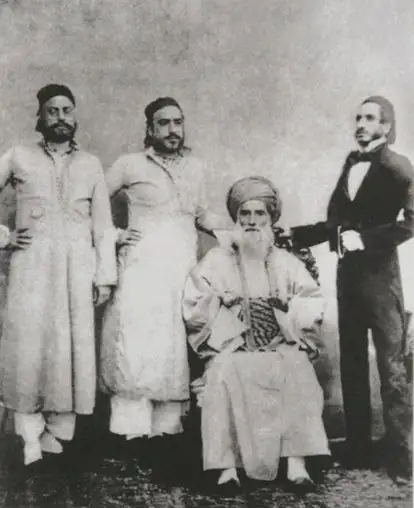
- Born
- 1832
- Known as
- merchant family, opium traders, cotton millers, property developers
- Also written
- Sassoons · Sassoon dynasty · 沙逊洋行
Loading map…
Why Shanghai knows the name
The Sassoons were a Jewish merchant family from Baghdad who built their fortune in Bombay and then in China, first in opium and cotton, later in Shanghai real estate. Their name sits on Sassoon House, the Bund tower that is now the Peace Hotel, and on two firms, Old Sassoon and New Sassoon, that once traded across Asia. Shanghai’s Chinese records call them 沙逊 (Shāxùn).
Where did the family come from?
David Sassoon was born in Baghdad in October 1792 and served as the city’s treasurer from 1817 to 1829. Sixth Tone says the family left after the city’s new governor stirred up hostility; Wikipedia, citing Jackson, says David and his father were persecuted by the pasha. The family settled in Bombay, where David Sassoon & Co. began trading in 1832 from a counting house on Tamarind Street. The date of the move itself is uncertain: Betta says David chose Bombay in 1830, one passage in Wikipedia says the family arrived in 1832, and another says it moved after his father’s death in 1830.
In Bombay he built the Magen David Synagogue at Byculla and, in Pune, the Ohel David Synagogue, and he funded schools, a library, a hospital and a benevolent institution that still carried his name. David died in Poona on 7 November 1864. His sons ran the firm after him, with the eldest, Abdallah, later Sir Albert Sassoon, partner from 1852 and Elias David Sassoon joining soon after.
One of Elias’s sons, Joseph, died in Shanghai in 1868; in 1878 Elias founded the Jewish cemetery at Chinchpokli in Bombay in his memory. It is a small reminder of how closely Bombay and Shanghai were linked in the family’s life.
When did they open in Shanghai?
China came after the First Opium War. The sources give the offices slightly different dates. Betta writes that the firm opened an office in Hong Kong in 1843 and in Shanghai in 1845, and that the Shanghai office remained the main focus of its China business for the next century. Maisie Meyer writes that Elias David Sassoon pioneered the settlement of Baghdadi Jews in Shanghai around 1845 and that within five years the firm had offices in Hong Kong and along the coast. Wikipedia says Elias reached Canton in 1844 and moved to Shanghai the next year.
Shanghai changed the family’s staffing as well as its balance sheet. The Sassoon firms recruited managers, clerks and warehouse men from Baghdad and India, and a 1906 directory counted 22 of Shanghai’s 42 Baghdadi employees on Sassoon payrolls. Baghdadi Jews in the city never numbered more than about 1,000, Meyer notes. The Sassoons sponsored the Beth El synagogue in 1887, and a bequest from Sir Jacob Sassoon paid for its replacement, Ohel Rachel, in 1920. Until 1904 Baghdadi seats on the Shanghai Municipal Council were held by partners in Sassoon firms, which gave the family a direct voice in the Settlement’s affairs.
Why were there two Sassoon firms?
After David’s death the family split. Wikipedia, citing Jackson, says Elias David Sassoon left in 1867, three years after his father’s death, after quarrels with his brothers, and set up E. D. Sassoon & Co. with offices in Bombay and Shanghai. Sixth Tone and a Chinese firm dictionary say the new firm was formed in 1872. The Chinese names for the two houses, 老沙逊 (Old Sassoon) and 新沙逊 (New Sassoon), date from that division.
The new firm grew faster. In the Edwardian years its capital was £1.25–1.5 million, against about £0.5 million for the older house. It also moved earlier into cotton mills, buying the bankrupt Alexandra Mills in 1879, and by the Second World War it owned 15 mills with more than 30,000 employees.
Two later chapters of the family’s history are told in the entries for the firms themselves; see the profiles of David Sassoon & Co. and E. D. Sassoon & Co.
How much of the opium trade was theirs?
Opium was a main line for both firms, and the sources are careful to place it in the context of a trade many merchants joined. Wikipedia says David Sassoon & Co. undercut British rivals in the 1860s by buying the crop before harvest. Dent & Co. went bankrupt in 1867 and Jardine Matheson stopped being an important opium dealer by the early 1870s. The same article says the Sassoon firm handled around 70 per cent of the Indian opium traded in that decade, but gives no source for the number. A second article on Elias says the family fleet carried about one-fifth of the opium imported into China. The two figures measure different things, the share of Indian opium handled and the share of Chinese imports carried, so they are not in conflict, but neither is firmly sourced here.
In 1907 Britain agreed to phase out opium exports to China over the following decade. E. D. Sassoon & Co. then withdrew, and Meyer dates the end of the trade conducted by Baghdadi merchants to 1917. The Sassoons also did banking: David Sassoon & Co. is described as one of the merchant houses behind the Hongkong and Shanghai Bank in 1865.
What did the family mean to Shanghai’s Jewish community?
For decades the Sassoons were the community’s paymasters. When the American traveller Simon Adler Stern visited in 1888, he wrote that the congregation, then 30 to 40 members, would not have survived without the liberality of the Sassoon family. The family’s money also built the synagogues that replaced the first one. Relations were not always easy. Betta reports that Victor Sassoon was sometimes greeted in bars in the 1930s with a chant of “Back to Baghdad”, a taunt aimed at the community’s origins.
The family’s last public role in Shanghai came with the refugees of the late 1930s. By the end of 1939 relief committees were caring for about 16,000 refugees from Europe, and Meyer says Victor Sassoon housed some 2,500 of them. His entry describes how.
Who ran the firms after the founders?
Leadership passed through sons and sons-in-law. Sir Jacob Elias Sassoon took over E. D. Sassoon & Co. when Elias died in 1880 and opened branches in Calcutta and Karachi. The firm became a limited company on 1 January 1921, shortly before Victor’s generation took over. David Sassoon & Co. went joint-stock in 1901 with £500,000 of capital, and shares went to non-family managers for the first time. After Sir Edward Sassoon died in 1912, Frederick David Sassoon dominated it until his own death in 1917; David Gubbay then chaired it until he died.
The Shanghai office worked at a smaller scale than these figures suggest. Betta reports that Sassoon firms kept their opium records in English by the 1880s, which set them apart from smaller Baghdadi traders, and that the Baghdadi community elected a councillor to the British quota of six seats on the Municipal Council almost every year between 1869 and 1921. Not every career ended well: a former E. D. Sassoon employee, Benjamin David Benjamin, nearly went bankrupt in 1883 after a short rise as a sharebroker and property dealer.
How did Shanghai become a property business?
The Sassoons had held land on the Bund and Nanjing Road since the 1870s. In 1923 E. D. Sassoon & Co. bought the majority of the shares in Arnhold & Co. of Shanghai, whose subsidiary, the Cathay Land Company, owned flats and a hotel. Victor Sassoon, who took over the family business (the gazetteer says in 1918; other sources after his father’s death in 1924), used it as the base for the building programme described in his entry: Sassoon House (Cathay Hotel, now the north building of the Fairmont Peace Hotel) in 1929, Cathay Mansions and Grosvenor House, and later blocks. The Shanghai gazetteer records the commercial logic: the Settlement taxed land by area, so tall blocks made far more money than low houses.
Betta notes that by the late 1920s the Sassoon firms’ overall importance in Shanghai had shrunk. The property boom of the 1930s therefore marks a change of business, from trade to rents, and the Sassoon holdings in the city grew even as the old merchant role faded. By one archive’s count Victor Sassoon owned over 1,800 properties there at his peak.
Who else is tied to the family?
Silas Hardoon is the best-known Shanghai figure whose career crossed theirs. The Shanghai gazetteer says the Sassoon firm sent him to Shanghai in 1873, that he left it in 1886 for the property department of the New Sassoon firm, and that he later built his own property business. English Wikipedia gives an earlier arrival, 1868.
What the sources disagree on
- Move to Bombay: 1830 or 1832.
- China offices: Hong Kong 1843 or 1844; Shanghai 1845 in most accounts.
- Founding of E. D. Sassoon & Co.: 1867 (Wikipedia, citing Jackson) or 1872 (Sixth Tone, a Chinese firm dictionary).
- Opium share: about 70 per cent of Indian opium traded (unsourced) or one-fifth of Chinese imports carried by the family fleet.
How did the Shanghai chapter end?
Japanese forces seized the Cathay Hotel and other Sassoon holdings after 8 December 1941. After the war the family’s capital was moved out of China; the gazetteer says the Shanghai businesses were transferred in 1958 to a Chinese state company against unpaid tax. David Sassoon & Co. survived much longer in London, where it was sold for about £2 million in 1982. E. D. Sassoon’s banking subsidiary passed to Wallace Brothers in 1972 and was taken over by Standard Chartered in 1976.
What to look for
Sassoon House, at the Bund end of Nanjing Road, is the most visible trace. The green pyramid roof is the part you can recognise from across the river. For the family’s later apartment towers, the two Jin Jiang buildings on Changle Road and Maoming South Road (Cathay Mansions and Grosvenor House) show the same architects’ hand. What has gone is the Sassoon name itself on the businesses: in Shanghai it now survives mainly on the buildings and in the phrases 老沙逊 and 新沙逊.
What Shanghai says, and what the record shows
Popular stories, told in our words, checked against the sources listed below.
- Sources disagree
The story: The Sassoons were the opium kings of China and made their fortune on the drug.
The record: Sources agree that opium was a main line for David Sassoon & Co. and E. D. Sassoon & Co. They disagree on the size of the share: one encyclopaedia entry says the firm handled around 70 per cent of the Indian opium traded by the early 1870s but gives no source for the figure, while another says the family's fleet carried about one-fifth of the opium imported into China. Other merchants traded opium too, including Jardine Matheson and Dent & Co.4,5
- Sources disagree
The story: David Sassoon founded the Hongkong and Shanghai Bank.
The record: Sixth Tone says he co-founded the bank in 1864, while Wikipedia, citing Stanley Chapman, says David Sassoon & Co. was part of the merchant consortium that set it up in 1865. The sources give the firm a place among the backers but not a founding role; the bank's own founders' list was not checked here.3
- Unproven
The story: 沙逊 and 沙宣 are two different families, or one of them is a mistake.
The record: Shanghai's own records, including the municipal gazetteer and the building registers, write the family name 沙逊, and a Chinese firm dictionary calls the two firms 老沙逊 and 新沙逊. I found no Shanghai source that uses 沙宣 for the family and no source that explains the variants.8
Timeline
- 1792David Sassoon born in Baghdad1
- 1832David Sassoon & Co. founded in Bombay4
- 1845Shanghai office opens (Hong Kong office 1843, by one count)2
- 1864David Sassoon dies; the Hongkong and Shanghai Bank is founded with Sassoon backing1,3
- 1867Elias David Sassoon leaves to found E. D. Sassoon & Co. (1872 in some accounts)3,4
- 1887Sassoons sponsor Shanghai's Beth El synagogue2
- 1907Britain agrees to wind down opium exports to China over ten years5
- 1923E. D. Sassoon buys the majority of Arnhold & Co., owner of the Cathay Land Company2
- 1929Sassoon House and the Cathay Hotel open on the Bund9
- 1941Japanese forces seize the Sassoon holdings in Shanghai10
- 1958Remaining Shanghai businesses transferred to a Chinese state company10
Their Shanghai on the map
Tap a name in the text, or “map” in this list, to see where it is; names with their own page link to it.
- 01Sassoon House (Cathay Hotel, now the north building of the Fairmont Peace Hotel)沙逊大厦(华懋饭店)builtmapThe family's Bund corner since the 1870s; the 1929 tower is now the Fairmont Peace Hotel.
- 02Cathay Mansions and Grosvenor House (now the Jin Jiang Hotel)华懋公寓与峻岭公寓(今锦江饭店)builtmapTwo Sassoon apartment towers of 1929 and 1934–35 in the former French Concession, now a hotel.
Members
 David Sassoon & Co.老沙逊洋行(est. 1832)
- E. D. Sassoon & Co.新沙逊洋行(1867–1958)
- Elias David Sassoon以利亚·大卫·沙逊(1820–1880)
- Sir Victor Sassoon维克多·沙逊(1881–1961)
Connections
- David Sassoon & Co.老沙逊洋行Old Sassoon: the firm David Sassoon founded in Bombay in 1832
- E. D. Sassoon & Co.新沙逊洋行New Sassoon: E. D. Sassoon & Co., founded by Elias David Sassoon
- Elias David Sassoon以利亚·大卫·沙逊Elias David Sassoon, second son of the founder
- Kadoorie family嘉道理家族Elly Kadoorie began as an employee of the Sassoon firm and later became a rival
 Silas Aaron Hardoon哈同Silas Hardoon worked for the Sassoon firms in Shanghai before running his own business
- Sir Victor Sassoon维克多·沙逊Sir Victor Sassoon, the family member who moved the business to Shanghai
Places


Building· 1935
Jin Jiang Hotel
锦江饭店Jǐnjiāng Fàndiàn
Two Sassoon apartment towers of 1929 and 1935, a state guesthouse since 1951 and the place where the 1972 Shanghai Communiqué was signed.


Building· 1926–1929
Sassoon House (Fairmont Peace Hotel)
沙逊大厦Shāxùn Dàshà
Victor Sassoon's 1929 granite tower with the green copper pyramid, home of the Cathay Hotel and since 1956 the Peace Hotel, now run by Fairmont.
Stories
Sources
- 1.David Sassoon (treasurer) (English Wikipedia; cites Jackson 1989, Kaufman 2020) (David Sassoon (treasurer)), Wikipedia — Early life; Death sections; Bombay section, citing Jackson pp. 5–12 and 17–19; Philanthropy sectionwikipedia
- 2.From Orientals to Imagined Britons: Baghdadi Jews in Shanghai (From Orientals to Imagined Britons: Baghdadi Jews in Shanghai), Chiara Betta, Modern Asian Studies 37(4), Cambridge University Press (text read at jewsofchina.org), 2003 — section on the Sassoon firms; section on Baghdadi firms and the 1906 directory; sections on religious organisation and the Municipal Council; closing section on the Sassoon firms; sections on the Municipal Council and on Benjamin David Benjamin; paragraph on opium records; sections on Beth El and on Sir Victor Sassoonarticle
- 3.From Baghdad to the Bund: The Family That Built Shanghai (From Baghdad to the Bund: The Family That Built Shanghai), Huang Wei (translated by David Ball), Sixth Tone, 2022 — section on origins; section on Shanghai 1843–1865; section on Old and New Sassoonarticle
- 4.David Sassoon & Co. (English Wikipedia; cites Jackson 1989, Stansky 2003, Chapman 2006, J. Sassoon 2022) (David Sassoon & Co.), Wikipedia — Founding, citing Stansky 2003, p. 5; Founding, citing Jackson 1989, pp. 19 and 30; Banking, citing Chapman 2006, p. 135; 1867 split; Opium trade section, citing Jones 2007 p. 41 and Thampi 2017 p. 40 for the Jardine points; Later decline, citing J. Sassoon 2022 p. 286; Corporate changes and leadershipwikipedia
- 5.Baghdadi Jews in Early Shanghai (Baghdadi Jews in Early Shanghai), Maisie J. Meyer, Iraqi Jewish Association of Ontario (ijao.ca), 2009 — opening section; opium paragraph; community section; section on refugeesarticle
- 6.Elias David Sassoon (English Wikipedia) (Elias David Sassoon), Wikipedia — China section; infobox and Early life; Career; Career section; Philanthropy sectionwikipedia
- 7.E. D. Sassoon & Co. (English Wikipedia; cites Jackson 1989, Chapman 2006, Thampi 2017) (E. D. Sassoon & Co.), Wikipedia — opening section; section on Opium; Cotton section, citing Chapman 2006 p. 131; Property and Sir Victor Sassoon sections; Closing section; Other dated factswikipedia
- 8.Dictionary of Foreign Firms in China, entry Old Sassoon / New Sassoon (as transcribed in the MAD Space database; seen only as a search-result snippet) (外国在华商行辞典 条目:老沙逊/新沙逊(MAD Space 广告商数据库转录)), MAD Space database, citing 四川人民出版社 1995, 1995 — entry text, as seen in a search snippet; entry headingwebsite
- 9.Shanghai Famous Buildings Gazetteer: five Bund entries (nodes 108924 North China Daily News Building, 108925 Chartered Bank, 108926 Palace Hotel, 108927 Sassoon House, 108928 Bank of China) (上海名建筑志 · 欧美风情的沪滨广厦(字林大楼、麦加利银行大楼、汇中饭店、华懋饭店大楼、中国银行大楼各篇)), 上海市地方志办公室, 2009 — Sassoon House entry (node 108927); Sassoon House entry titlegazetteer
- 10.Wartime Shanghai: A Tycoon Triumphs Over the Emperor (World War II magazine, September 2006) (Wartime Shanghai: A Tycoon Triumphs Over the Emperor), Eric Niderost, HistoryNet / World War II magazine, 2006 — paragraphs on the Japanese occupationarticle
- 11.Shanghai Concessions Gazetteer, part 6 People, ch. 1 Biographies: Victor Sassoon (1881–1961) (上海租界志·第六篇 人物·第一章 人物传略·维克多·沙逊(Elias Victor Sassoon 1881~1961年)), 上海市档案馆(编), 上海社会科学院出版社;上海市地方志办公室数字方志(在线), 2001 — closing sentences; entry heading and textgazetteer
- 12.Shanghai Concessions Gazetteer, part 6 People, ch. 1 Biographies: Silas Aaron Hardoon (1846–1931) (上海租界志·第六篇 人物·第一章 人物传略·哈同(Silas Aaron Hardon 1846~1931年)), 上海市档案馆(编), 上海社会科学院出版社;上海市地方志办公室数字方志(在线), 2001 — life of Silas Aaron Hardoon, first paragraphgazetteer
- 13.Silas Aaron Hardoon (English Wikipedia; seen only as a search-result summary) (Silas Aaron Hardoon), Wikipedia — career sectionwikipedia