People · Firm
Gibb, Livingston & Co.
仁记洋行Rénjì Yángháng · est. 1836
Scottish-run hong founded at Canton in 1836; opened in Shanghai in 1844, gave Jinkee Road its name and acted as agent for insurers and shipping lines.
- Founded
- 1836
- Known as
- trading house, insurance and shipping agent
- Also written
- Gibb · Livingston & Company · Gibb Livingston · Jinkee · 仁記洋行
Loading map…
Why Shanghai knows the name
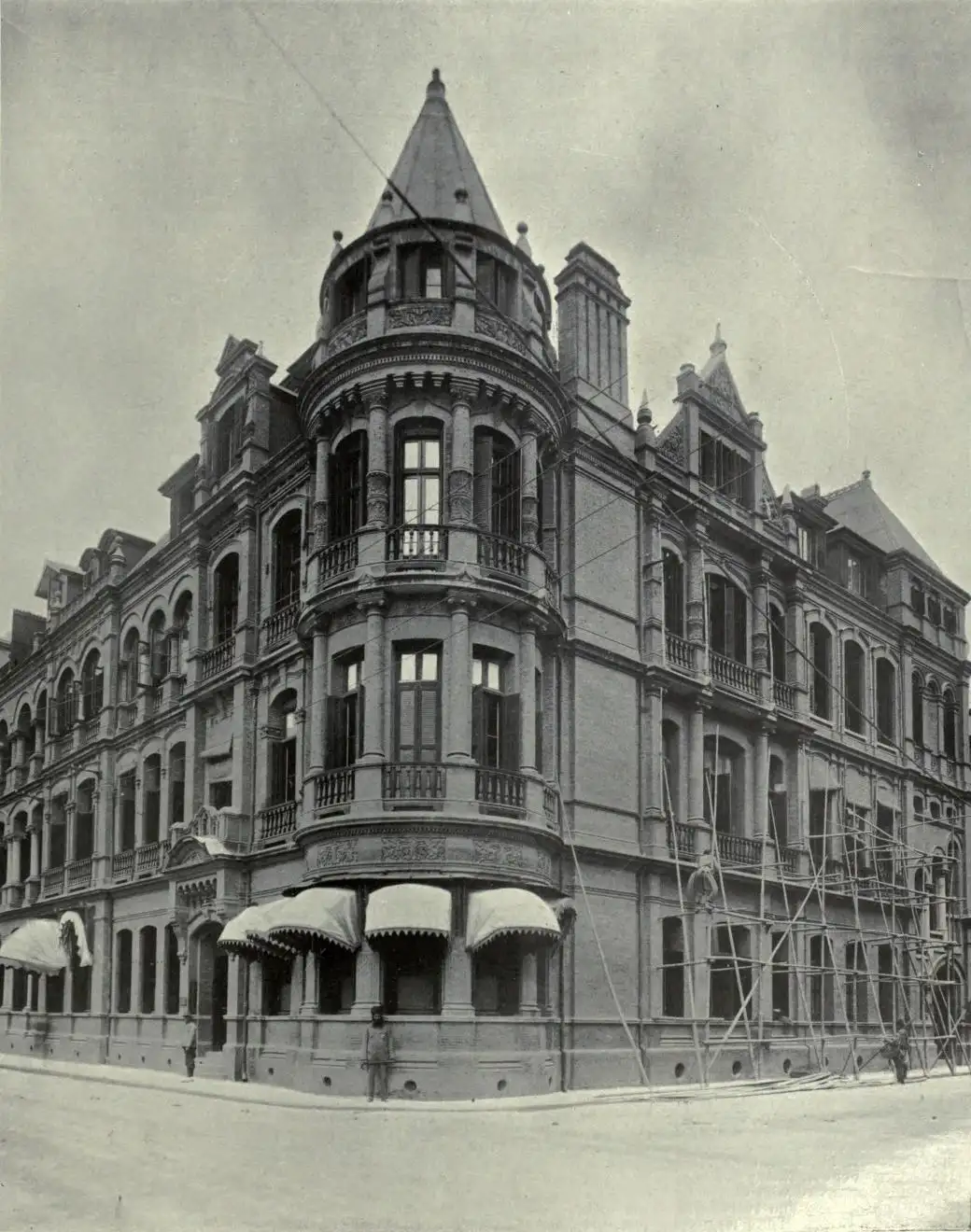
Gibb, Livingston & Co. (仁记洋行, Rénjì Yángháng) was a Scottish-run trading house that opened a Shanghai branch in 1844 and gave a street its name. The street was Jinkee Road, now Dianchi Road (滇池路, Diānchí Lù), and the name came from the firm’s Chinese name, spelled “Jinkee” in the Cantonese way. The firm made its Shanghai reputation as an agent, representing insurers and steamship lines rather than owning a fleet, and its offices at 100 Jinkee Road were built in 1908.
Who founded it, and how did it get to Shanghai?
Two Scots, Thomas Augustus Gibb and William Potter Livingston, both former East India Company employees, founded the firm at Canton on 1 July 1836. When the First Opium War closed the Canton trade, the partners moved to Macao, and in 1841 to the new colony of Hong Kong, where the firm set up premises off Queen’s Road. In 1844 John Darby Gibb opened a branch at Shanghai, one year after the first British houses arrived there. The Wikipedia entry places the branch at Cadastral Lot No. 2 on Jinkee Road.
By 1845 the partners included the two founders, Joseph G. Livingston, J. Skinner, Thomas Jones, George Gibb, W. H. Warley and J. D. Gibb. Hugh Gibb, the senior partner in 1855, later chaired the Hong Kong General Chamber of Commerce and sat on the Legislative Council, according to the Hong Kong history I read. By 1864 the firm had branches at Foochow (Fuzhou), Hankow and Kiukiang as well as Canton and Shanghai, and by 1869 the principals were T. A. Gibb, J. D. Gibb, H. B. Gibb and E. F. Duncanson.
What did it sell?
Early trade centred on exporting tea and importing cotton and woollen goods, and the firm also traded in opium. A Fuzhou branch handled the tea trade, and the firm’s clippers worked from that port. That makes Gibb, Livingston a smaller version of the same pattern as Jardine and Dent: Canton origins, an opium stake, and tea as the return cargo. The sources I read give no volumes, so I cannot say how big the opium share was.
Why did the firm become an agent?
The longest-lasting part of the business was agency work. The firm represented many insurers, among them North British and Mercantile and Allianz, and acted for the Ben Line of Steamers, the Eastern and Australian Steamship Company and the Peninsular and Oriental Steam Navigation Company. These agencies earned commission without tying up capital in ships. In Shanghai terms it meant that a visitor to the Bund who wanted to insure cargo or book passage could do so at Jinkee Road. The firm became a limited liability company in 1920.
Who were its compradors?
The sources I could reach name none. The Hong Kong history lists foreign partners and agencies but is silent on the Chinese staff, and the Wikipedia article does not mention them. Every foreign house in the treaty ports needed a comprador to deal with Chinese merchants, so Gibb, Livingston had one or more; the Jardine entry names Tong King-sing and the Dent entry names Xu Yuting and his nephew Xu Run, which shows what the surviving records can offer when they exist. For Gibb, Livingston the place to look is the firm’s own papers, which I have not found catalogued.
How did it compare with the houses that came in 1843?
Jardine Matheson and Dent & Co. each came to Shanghai a year earlier, and each had a distinct specialty: Jardines became an industrial and shipping group and Dent collapsed in 1867. Gibb, Livingston took a third course, as a long-lived agency house. By 1864 it had branches at four other river and coast ports, and it survived as a company until its purchase in 1962. The Borneo Company’s purchase in 1962 and Inchcape’s in 1967 mean the name was absorbed into larger groups rather than closed down, a quieter end than Dent’s bankruptcy or Jardines’ withdrawal from the mainland in 1954.
What does 仁记 mean, and where does the road name come from?
The Chinese name is written 仁記 in traditional characters and 仁记 in simplified, read Rénjì in Mandarin. In the first character, 仁, the dictionary sense is humaneness or benevolence, and 记 is a common suffix for a shop or firm. That reading comes from the characters themselves; none of the sources I read says the partners chose the name to carry that meaning. “Jinkee” is the Cantonese reading of the same two characters, the form Westerners from Canton and Hong Kong carried to Shanghai. Two accounts say the road took the name from the firm.
Where in Shanghai was it?
Jinkee Road ran off the Bund. The coordinate on the map is an estimate based on where Dianchi Road meets the waterfront; I have not checked it against a map. The 1908 photograph captioned “Gibb Livingstone & Co. Building” shows the later offices, not the 1844 premises. Nothing I read says the 1908 building survives, and I cannot say who occupies the address today.
Was it really “Lot 2”?
The Bund tradition says lot numbers followed the order in which foreigners arrived. For Gibb, Livingston the number would make it the second on the river. The evidence is thin. Wikipedia states the lot number for the firm, but Jardine Matheson and Dent & Co. were both in Shanghai in 1843, a year before Gibb, Livingston, and Jardines is said to have registered first. If the order matters at all, it is the order of registration rather than arrival, and no source I read gives the register. The Jardine entry reaches the same conclusion from the other direction.
What the sources disagree on
- The lot: the number is given in one source only.
- The Shanghai offices: the Hong Kong article places the offices at 100 Jinkee Road in 1908, while Wikipedia places the 1844 branch on Lot No. 2; whether these are the same plot is not stated.
- The founding of the Shanghai branch: both accounts say 1844, but neither cites a Shanghai record.
What happened to the firm?
The Borneo Company Limited bought Gibb, Livingston & Co. in 1962, and Inchcape plc acquired the Borneo Company in 1967. Nothing in the sources I read describes what happened to the Shanghai branch after 1949. This is one of the gaps to fill from the Shanghai Municipal Archives or the firm’s papers.
For scale, Sixth Tone reports that more than 1,800 foreign firms from 34 countries opened in Shanghai between 1843 and 1949. That is a count of openings over a century, not of firms operating at one time, but it puts Gibb, Livingston in context: one of the first, and one of a very large number.
What to look for
Find Dianchi Road on a current map of the Bund area. The road keeps the firm’s story in its earlier name, but I have found no plaque or surviving building, and the 1908 offices at No. 100 may have been rebuilt. A good visit here is a short one: read the street sign and think of the Cantonese name that gave the road its first label.
What Shanghai says, and what the record shows
Popular stories, told in our words, checked against the sources listed below.
- Supported
The story: Jinkee Road, now Dianchi Road, was named after the firm.
The record: Both accounts I read say the street took its name from the firm's Chinese name, 'Jinkee', the Cantonese-style rendering of 仁记. I found no independent land or Council record of the naming.1
- Unproven
The story: Bund lot numbers were handed out in order of arrival, so Gibb, Livingston, on Lot 2, was the second foreign firm ashore.
The record: Wikipedia gives 'Cadastral Lot No. 2' for the 1844 Shanghai branch, but the source I could read does not say how lots were numbered or whether the order tracked arrivals. The 1843 openings of Jardine Matheson and Dent & Co. would make 'second' wrong in any case.1,3
Timeline
- 1836Founded at Canton on 1 July by Thomas Augustus Gibb and William Potter Livingston1
- 1841Moves to Hong Kong, premises off Queen's Road1
- 1844John Darby Gibb opens the Shanghai branch1
- 1864Branches at Foochow, Hankow and Kiukiang as well as Canton and Shanghai2
- 1908Shanghai offices at 100 Jinkee Road built1
- 1920Becomes a limited liability company1
- 1962Bought by the Borneo Company Limited1
Their Shanghai on the map
Tap a name in the text, or “map” in this list, to see where it is; names with their own page link to it.
- 01Jinkee Road (now Dianchi Road), approximate position仁记路(今滇池路)foundedThe firm's Shanghai offices stood at 100 Jinkee Road; the road is now Dianchi Road. Position approximate, near the Bund end.approximate position
Connections
- Dent & Co.宝顺洋行Another 1840s hong opening in Shanghai, 1843–44
- Jardine, Matheson & Co.怡和洋行Fellow Canton-era hong; Gibb, Livingston is placed on Bund Lot 2 and Jardines is described as the first to register a Bund lot
Stories
Sources
- 1.Gibb, Livingston & Co. (Wikipedia) (Gibb, Livingston & Co.), Wikimedia Foundation — opening paragraphs; Shanghai paragraph and 1908 photo caption; businesses section; later fate; Chinese name sectionwikipedia
- 2.Gibb, Livingston & Company Ltd (Industrial History of Hong Kong Group) (Gibb, Livingston & Company Ltd, established in HK 1841, shipping lines and insurance), Industrial History of Hong Kong Group — origins and Hong Kong paragraphs; Shanghai and Jinkee paragraph; trade paragraph; partners and expansion paragraphs; corporate changes paragraph; agencies paragraphwebsite
- 3.Jardine Matheson Building (Wikipedia) (Jardine Matheson Building), Wikimedia Foundation — Timeline sectionwikipedia
- 4.History of Jardine Matheson & Co. (Wikipedia) (History of Jardine Matheson & Co.), Wikimedia Foundation — Shanghai timeline, 1843 entrywikipedia
- 5.Dent & Co. (Wikipedia) (Dent & Co.), Wikimedia Foundation — Shanghai sectionwikipedia
- 6.From Baghdad to the Bund: the family that built Shanghai (From Baghdad to the Bund: the family that built Shanghai), Sixth Tone — background paragraphsarticle